
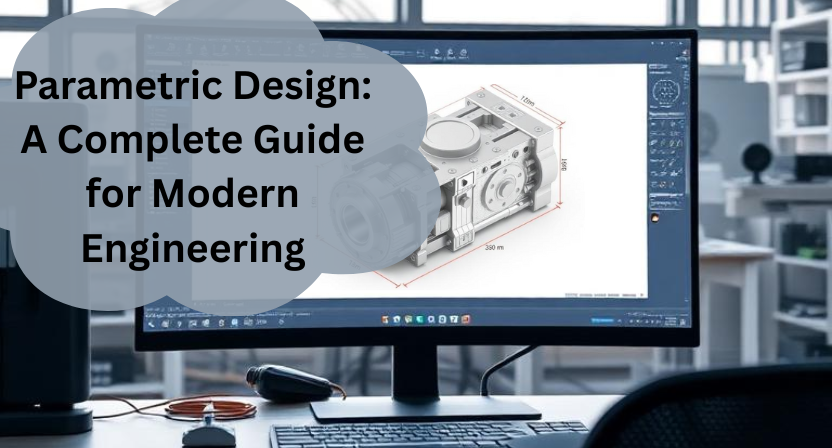
In today’s fast-paced engineering environment, design teams are expected to work faster, smarter, and with fewer errors. Products are becoming more complex, customer requirements change frequently, and timelines are tighter than ever. In this context, Parametric Design has emerged as a powerful approach that helps engineers manage complexity while maintaining flexibility and accuracy.
This guide explains what parametric design is, how it works, and why it has become essential for modern engineering teams.
What Is Parametric Design?
Parametric Design is a modeling approach where the geometry of a component or assembly is driven by parameters such as dimensions, constraints, equations, and relationships. Instead of creating static geometry, engineers define rules that control how a model behaves when inputs change.
For example, changing a single parameter like length or diameter can automatically update related features, drawings, and even assemblies. This makes the design adaptable and easier to modify without starting from scratch.
How Parametric Design Works
At its core, parametric design is based on three key elements:
- Parameters
These are values such as dimensions, angles, or material thickness that control the model. - Constraints and Relationships
Constraints define how features relate to each other (parallel, concentric, symmetric, etc.), while relationships ensure consistency when parameters change. - Feature History
Most parametric CAD systems record design steps in a logical sequence, allowing engineers to revisit and modify earlier features without breaking the model.
Together, these elements allow engineers to build intelligent models that respond predictably to changes.
Why Parametric Design Matters in Modern Engineering
1. Faster Design Iterations
Design changes are inevitable. It allows engineers to make quick updates without reworking the entire model, saving valuable time during development.
2. Improved Design Accuracy
Because relationships are predefined, the risk of inconsistent dimensions or mismatched features is significantly reduced.
3. Better Design Reuse
Parametric models can be reused across multiple projects or product variants simply by adjusting key parameters.
4. Enhanced Collaboration
Clear design intent makes it easier for multiple teams to work on the same model, especially in distributed or global engineering environments.
Parametric Design vs Traditional Modeling
Traditional modeling often results in fixed geometry. Any major change requires manual edits, which increases the risk of errors and inconsistencies.
Parametric design, on the other hand:
- Maintains design intent
- Adapts easily to changes
- Supports automation and scalability
This makes it far more suitable for modern, agile engineering workflows.
Applications of Parametric Design
It is widely used across industries, including:
- Mechanical Engineering – Product families, assemblies, and configurable components
- Manufacturing – Design for manufacturability and quick customization
- Automotive & Industrial Equipment – Platform-based product development
- Engineering Digitalization – Model-based workflows and data-driven design
It also plays a critical role in preparing engineering data for downstream digital processes such as PLM integration and digital twins.
Parametric Design and Engineering Digitalization
As companies move toward engineering digitalization, it acts as a foundation. Well-structured parametric models enable smoother data flow across CAD, PLM, simulation, and manufacturing systems.
When models are built with clear parameters and relationships, they become easier to manage, update, and integrate into digital engineering ecosystems.
Best Practices for Effective Parametric Design
- Plan the design intent before modeling
- Use meaningful parameter names
- Keep relationships simple and logical
- Avoid over-constraining the model
- Document key assumptions for future users
Following these practices ensures that parametric models remain stable, flexible, and easy to maintain.
Conclusion
Parametric Design is no longer just a CAD feature it is a strategic approach that supports efficiency, accuracy, and scalability in modern engineering. By enabling faster design changes, better reuse, and seamless integration with digital workflows, it helps engineering teams stay competitive in a rapidly evolving industry.
At Qaxles Technologies, we support product development teams with parametric CAD modeling, lightweight model creation, engineering documentation, and engineering digitalization services. Our focus is on building clean, flexible, and production-ready models that align with modern digital engineering workflows and long-term scalability.
If you are looking to improve design efficiency and adopt smarter engineering practices, it is the right place to start with the right partner by your side.