
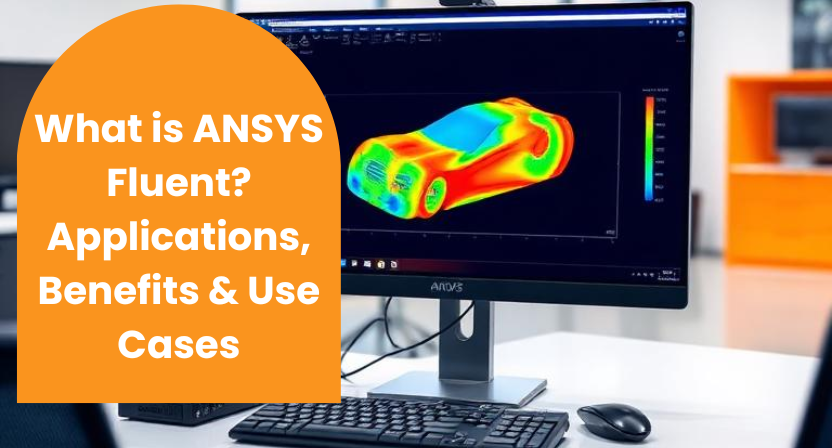
If you’ve ever wondered how engineers predict airflow over a car, analyze heat transfer in electronics, or simulate fluid movement inside a pump, there’s a good chance they’re using ANSYS Fluent.
It’s one of the most widely used tools in computational fluid dynamics (CFD), helping engineers solve complex fluid flow problems without needing expensive physical prototypes.
Let’s break it down in a simple, practical way.
What is ANSYS Fluent?
ANSYS Fluent is a powerful simulation software used for analyzing fluid flow, heat transfer, and related physical phenomena.
In simple terms:
It helps engineers visualize and predict how liquids and gases behave under different conditions.
Instead of testing designs physically again and again, engineers can simulate:
- Airflow
- Temperature changes
- Pressure variations
- Fluid movement
All within a virtual environment.
Why is ANSYS Fluent Important?
Traditional testing methods can be:
- Time-consuming
- Expensive
- Limited in flexibility
With ANSYS Fluent, you can:
- Test multiple design variations quickly
- Identify issues early in the design stage
- Improve product performance before manufacturing
This makes it a critical tool in modern product engineering.
Key Applications of ANSYS Fluent
ANSYS Fluent is used across multiple industries. Here are some of the most common applications:
1. Automotive Industry
Engineers use ANSYS Fluent to:
- Analyze airflow over vehicles (aerodynamics)
- Improve fuel efficiency
- Reduce drag and noise
2. Aerospace Engineering
In aerospace, precision is everything.
ANSYS Fluent helps in:
- Simulating airflow over aircraft wings
- Studying turbulence effects
- Optimizing lift and stability
3. Electronics Cooling
Overheating is a major issue in electronic devices.
Using ANSYS Fluent, engineers can:
- Analyze heat dissipation
- Design better cooling systems
- Improve product lifespan
4. Industrial Equipment
For equipment like pumps, compressors, and turbines:
It is used to:
- Optimize fluid flow
- Reduce energy consumption
- Improve efficiency
5. Energy Sector
In industries like oil & gas and renewable energy:
- Simulating fluid flow in pipelines
- Analyzing wind flow for turbines
- Studying combustion processes
Real-World Use Cases
Let’s make this more relatable with a few examples.
Designing a More Efficient Car
Instead of building multiple prototypes, engineers simulate airflow over different car designs to reduce drag and improve mileage.
Improving Cooling in Smartphones
Manufacturers use ANSYS Fluent to ensure devices don’t overheat, even with heavy usage.
Optimizing Pump Performance
Engineers simulate fluid movement inside pumps to improve flow rate and reduce energy loss.
Benefits of Using ANSYS Fluent
Here’s why it is widely trusted:
1. Faster Product Development
Simulations reduce the need for physical testing, saving both time and effort.
2. Cost Reduction
Fewer prototypes = lower development costs.
3. High Accuracy
Advanced models provide reliable and realistic results.
4. Design Optimization
You can test multiple design variations and choose the best one.
5. Versatility
From simple flow analysis to complex multiphase simulations, it handles it all.
Common Challenges (and What to Know)
While it is powerful, it’s not “plug and play.”
- Requires good understanding of fluid dynamics
- Setting up simulations correctly is crucial
- Results depend on input accuracy
That’s why experienced engineers make a big difference in getting meaningful results.
Who Should Use ANSYS Fluent?
It is ideal for:
- Mechanical engineers
- CFD analysts
- Product design teams
- R&D departments
- Engineering service providers
Whether you’re developing a new product or improving an existing one, this tool can significantly enhance your process.
Conclusion
It has become an essential tool for engineers who want to design smarter, faster, and more efficiently. By enabling accurate simulations of fluid flow and heat transfer, it reduces risks and improves product quality before anything is physically built.
At Qaxles Technologies, we leverage tools like this is to support clients in solving complex engineering challenges from fluid flow analysis to product optimization. With the right expertise and approach, simulation can become a powerful advantage in your product development journey.