
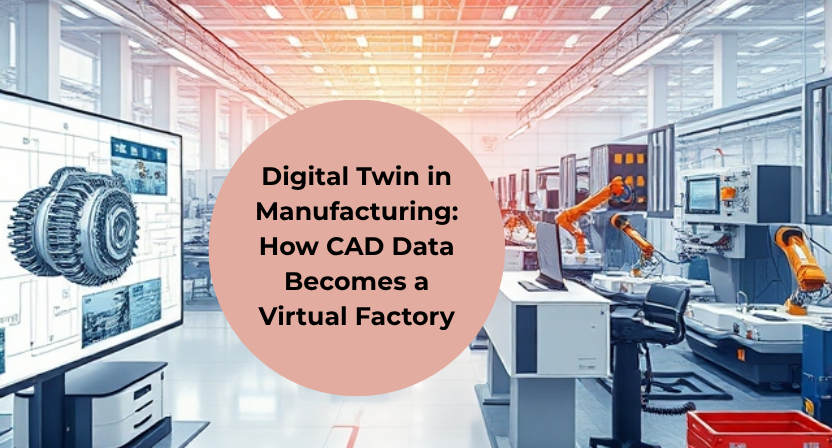
A manufacturing process often begins with a CAD model. An engineer creates the product, checks its dimensions, adds tolerances, and prepares the drawings needed for production. From there, the design moves through engineering, manufacturing, inspection, assembly, and eventually into the hands of the customer. However, the CAD model is only one part of this journey. Production teams also work with machine data, manufacturing instructions, bills of materials, quality records, engineering changes, and other information. When these different sources remain separate, it can become difficult to understand how a change in one area affects another. This is one reason digital twin in manufacturing has become an important topic for modern engineering teams. By connecting CAD information with manufacturing processes and real-world data, a digital twin can provide a much broader view of how a product and its production environment work together.
What Is a Digital Twin in Manufacturing?
A digital twin is a digital representation of a physical product, machine, process, or manufacturing environment. Unlike a traditional 3D model, however, it can include much more than geometry.
Depending on the application, a digital twin may combine CAD data, engineering specifications, production information, simulation results, machine data, sensor readings, and operational information. These connections allow engineers to study how a physical system behaves without relying entirely on physical testing.
For example, a manufacturer could use a digital twin to examine whether a new component fits an existing assembly. The same environment could also help evaluate machine movement, production layouts, material flow, or assembly sequences.
As a result, manufacturers can investigate potential problems earlier in the product lifecycle.
CAD Is the Foundation, Not the Complete Digital Twin
CAD plays an important role in creating a digital twin because it provides the engineering definition of the product. A typical model can contain geometry, assemblies, dimensions, materials, features, and relationships between components.
Nevertheless, a CAD model by itself does not explain everything that happens during manufacturing.
Consider a sheet-metal enclosure. The CAD assembly may show the panels, bends, holes, fasteners, and mounting locations. It does not necessarily show how the enclosure moves through the factory, which machine produces each component, how long assembly takes, or what happens when the design changes.
That additional information is what makes a digital twin more useful.
In simple terms, CAD describes the product, while a digital twin connects the product to the wider manufacturing environment.
How CAD Data Becomes a Virtual Factory
Creating a virtual factory does not mean simply importing a CAD assembly into another software application. Instead, manufacturers gradually connect product information with manufacturing processes, equipment, and operational data.
The process can be understood through several stages.
1. Begin With the Product CAD Model
Everything starts with an accurate digital definition of the product.
The CAD environment may contain:
- 3D models
- Assemblies
- Engineering drawings
- Dimensions
- Tolerances
- Material information
- Component relationships
- Design features
- Manufacturing requirements
For instance, an industrial cooling unit may contain hundreds of mechanical components. Its CAD assembly can provide the basic structure needed to understand how those components fit together.
Once this information is available, other product and manufacturing data can be connected to it.
2. Connect Product and Engineering Information
The next step is to connect the CAD model with the information used to manage the product.
That information can include:
- Bills of materials
- Part numbers
- Engineering specifications
- Revision history
- GD&T information
- Engineering change requests
- Engineering change orders
- Manufacturing drawings
- Quality requirements
- Material specifications
At this stage, PDM and PLM systems can become particularly valuable.
A product may go through hundreds of changes during its lifecycle. Without proper revision control, different departments could end up working with different versions of the same component.
By connecting CAD with controlled product data, manufacturers can create a more reliable digital foundation for the digital twin.
3. Add the Manufacturing Process
A product does not exist in isolation. It has to be manufactured, assembled, inspected, packaged, and delivered.
Therefore, the virtual environment also needs information about the production process.
Manufacturers can add details such as:
- Production machines
- Workstations
- Tools
- Assembly operations
- Manufacturing sequences
- Material movement
- Machine capabilities
- Production cycle times
- Factory layouts
Once this information is connected, engineers can begin looking at the relationship between the product and the factory.
For example, a new enclosure may fit perfectly in CAD but create an assembly problem because an operator cannot access a particular fastener. A virtual manufacturing environment can help identify that issue before the physical workstation is changed.
4. Use Simulation Before Making Physical Changes
Simulation gives engineers another way to test ideas.
Instead of immediately building a prototype or changing a production line, teams can examine different scenarios in a digital environment. This approach can be useful when the cost of physical experimentation is high.
Depending on the application, simulation can be used to study:
- Robot movement
- Machine operations
- Assembly sequences
- Material flow
- Production layouts
- Tool paths
- Equipment behavior
- Product performance
For CNC manufacturing, digital simulation can also help engineers verify machining operations before the program reaches the physical machine.
Consequently, potential collisions, incorrect movements, or other problems may be discovered earlier.
5. Bring Real Factory Data Into the Digital Model
The physical factory generates information continuously.
Machines can provide operating data, while sensors can record measurements and production systems can track output, downtime, and quality information. When useful data is brought back into the digital environment, the digital twin becomes more dynamic.
The relationship can be viewed as a continuous cycle:
Design → Simulation → Manufacturing → Operation → Data → Engineering
This feedback loop is important because the original design assumptions may not always match what happens in production.
For example, a manufacturing team might notice that a particular component regularly requires additional assembly time. That information could encourage engineers to review the design and look for a simpler assembly approach.
In this way, information from the factory can eventually influence future engineering decisions.
A Less-Discussed Benefit: Data Inheritance
There is another aspect of digital twins that deserves more attention: data inheritance.
Most discussions focus on creating a detailed virtual factory. Yet the bigger engineering challenge can be understanding how one design decision affects everything connected to it.
Imagine that an engineering team increases the width of a cooling-system enclosure from 800 mm to 900 mm.
At first glance, this looks like a simple CAD modification. In reality, the change could affect the sheet-metal drawings, bill of materials, packaging dimensions, assembly workstation, inspection requirements, tooling, and production planning.
When these systems are disconnected, engineers may need to identify those consequences manually.
A connected digital environment can make these relationships easier to trace.
This creates an interesting way to look at a digital twin: it is not only a virtual copy of the factory; it can also represent the chain of information created by engineering decisions.
That capability can be particularly useful for manufacturers dealing with frequent engineering changes or highly configurable products.
Benefits of Digital Twin in Manufacturing
The value of a digital twin depends on how it is implemented and what problem it is designed to solve. Even so, several areas can benefit from better connections between engineering and manufacturing data.
Earlier Design Validation
Physical prototypes can be expensive and time-consuming, especially for large or complex products.
With digital simulation and virtual testing, engineers can examine certain design decisions before committing resources to physical prototypes.
This does not eliminate physical validation. Instead, it can help teams arrive at physical testing with fewer obvious problems.
Better Manufacturing Planning
Production teams can review manufacturing processes before introducing them to the factory floor.
For example, engineers can examine workstation layouts, assembly access, machine movements, and material flow. As a result, some production problems can be addressed during planning rather than after installation.
More Effective Engineering Changes
Engineering changes rarely affect a single document.
A modification to one component may influence drawings, bills of materials, manufacturing instructions, tooling, inspection procedures, and assembly operations.
With connected product data, teams can better understand these relationships and assess the wider impact of a proposed change.
Improved Communication Between Teams
Mechanical engineers and manufacturing engineers often look at the same product from different perspectives.
The design team may focus on geometry and performance, while manufacturing teams are concerned with assembly, tooling, production time, and operator access.
A shared digital environment can give both groups a common reference point. Therefore, discussions about manufacturing problems can become more concrete and easier to visualize.
Reduced Dependence on Physical Experiments
Not every question needs to be answered by changing the physical factory.
When an appropriate simulation model is available, engineers can investigate several possible solutions digitally before selecting one for physical testing.
This can save time and reduce unnecessary disruption to production.
Digital Twin in Manufacturing and PLM
PLM can provide an important information layer for digital twin projects.
A digital twin is only as reliable as the information behind it. If an engineer is using an outdated CAD revision, the resulting analysis may not represent the actual product.
PLM helps manage information such as product structures, revisions, engineering changes, documents, and lifecycle relationships.
The relationship between these technologies can therefore be viewed in a straightforward way:
- CAD provides the product’s digital definition.
- PDM helps manage engineering files and revisions.
- PLM connects product information across its lifecycle.
- Simulation helps evaluate possible outcomes.
- Manufacturing systems describe how the product is produced.
- Operational data provides information from the physical environment.
When these layers work together, they can provide a stronger foundation for a manufacturing digital twin.
A Practical Example
Consider a manufacturer developing liquid-cooling equipment for data centers.
The mechanical engineering team creates a detailed CAD assembly containing the enclosure, manifolds, cold plates, brackets, piping connections, and other components. Engineering drawings and product information are then connected to the appropriate product structure.
Before production begins, the team can examine several practical questions.
Can the components be assembled without interference?
Does the operator have enough access around the equipment?
Can the required machines manufacture the components?
Is the workstation large enough for the assembly?
Will the proposed production sequence create unnecessary movement?
These questions become even more important when the product changes.
Suppose the manifold connection is moved to another location. That change may require a new enclosure panel, revised tubing, updated drawings, different assembly instructions, and changes to the inspection process.
A connected digital environment makes it easier to understand those relationships before the revised product reaches the factory.
Challenges Manufacturers Need to Consider
Digital twin projects can provide significant value, but they also require careful planning.
One common challenge is fragmented data.
A manufacturer may have several CAD platforms, legacy drawings, older machines, separate production systems, and different databases. Bringing all this information together can require considerable effort.
Data quality is another concern. A highly detailed 3D model will not automatically create a useful digital twin if its revision is outdated or its associated product information is incomplete.
Integration can also become difficult as the project expands.
For these reasons, manufacturers should avoid starting with an unnecessarily large digital twin project. Instead, it is often more practical to identify one manufacturing problem where connected digital information can provide clear value.
How to Start a Digital Twin Project
A manufacturer does not need to model an entire factory from the beginning.
A focused implementation can be easier to manage and evaluate.
A practical starting process could include:
- Choose one product or manufacturing process.
- Clean the relevant CAD and engineering data.
- Establish clear revision control.
- Connect the product structure with manufacturing information.
- Add the required machines, workstations, or production processes.
- Create simulations for the selected use case.
- Compare the virtual process with the physical process.
- Add real-world data where it can improve decision-making.
- Measure the results before expanding the project.
Starting small also makes it easier to identify gaps in data and integration before the digital twin becomes part of a much larger manufacturing environment.
Where Digital Twin Technology Is Heading
Manufacturing is becoming increasingly connected.
At the same time, technologies such as industrial IoT, simulation, cloud computing, automation, and AI are creating new opportunities to connect engineering information with physical operations.
The future of the digital twin is therefore not simply about creating a realistic 3D factory.
More importantly, it is about giving engineers a way to explore what could happen before making the physical change.
What happens if the design changes?
What happens if production volume increases?
What happens if a machine is relocated?
What happens if a component is replaced?
What happens if the assembly sequence changes?
These questions can be difficult to answer using disconnected drawings and spreadsheets alone. A connected digital environment can provide a more practical way to investigate them.
Conclusion
Digital twin in manufacturing begins with accurate information, but its real value comes from connecting that information across the product lifecycle.
CAD provides the foundation for the product definition. PDM and PLM help control and organize engineering information. Simulation allows teams to test different scenarios, while manufacturing systems describe how the product is built. Finally, operational data can bring information from the physical factory back into the engineering environment.
When these pieces work together, a CAD model can become much more than a digital representation of a product. It can become part of a connected virtual environment that helps engineering and manufacturing teams understand changes, test ideas, and make more informed decisions.
For companies looking to strengthen this foundation, Qaxles Technologies brings together mechanical CAD, engineering documentation, PLM/PDM support, engineering change management, and manufacturing-focused engineering services. These capabilities can help organizations build the structured engineering data needed for more connected digital manufacturing initiatives.
Ultimately, a useful virtual factory does not have to reproduce every detail of a physical facility. Its real purpose is to help engineers understand the consequences of important decisions before those decisions become expensive physical changes.