
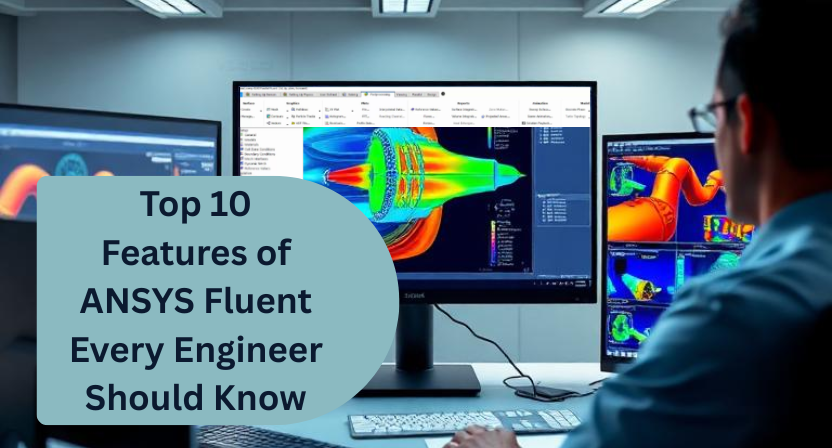
When it comes to computational fluid dynamics (CFD), few tools are as widely trusted and powerful as ANSYS Fluent. Whether you’re designing airflow systems, optimizing heat transfer, or analyzing complex fluid behavior, this software has become a go-to solution for engineers across industries.
But what truly makes it stand out? Let’s walk through the top 10 features that every engineer should understand to get the most out of ANSYS Fluent.
1. Advanced Turbulence Models
Turbulence is one of the most complex aspects of fluid flow. ANSYS Fluent offers a wide range of turbulence models from simple k-ε models to advanced Large Eddy Simulation (LES). This flexibility allows engineers to balance accuracy and computational cost based on project needs.
2. User-Friendly Interface
Despite its powerful capabilities, ANSYS Fluent is designed with usability in mind. The interface is intuitive, making it easier for beginners to navigate while still offering depth for experienced users.
3. High-Quality Meshing Integration
Accurate simulation starts with good meshing. Fluent integrates seamlessly with ANSYS meshing tools, allowing for structured and unstructured mesh generation. It also supports adaptive mesh refinement, improving accuracy in critical regions.
4. Multiphase Flow Modeling
From oil-water separation to bubble dynamics, ANSYS Fluent can simulate multiple interacting phases. It supports models like Volume of Fluid (VOF), Eulerian, and Mixture models making it ideal for real-world industrial applications.
5. Heat Transfer Capabilities
Whether it’s conduction, convection, or radiation, Fluent handles all modes of heat transfer efficiently. Engineers working in electronics cooling, HVAC, or energy systems rely heavily on this feature.
6. Customization with UDFs (User-Defined Functions)
One of the most powerful features is the ability to write custom functions using C programming. This allows engineers to define boundary conditions, material properties, or complex physical models tailored to unique problems.
7. Parallel Processing for Faster Simulations
Time is critical in engineering projects. ANSYS Fluent supports parallel computing, enabling simulations to run on multiple cores or even across clusters. This significantly reduces computation time for large models.
8. Robust Solver Technology
Fluent provides both pressure-based and density-based solvers. This ensures accurate results across a wide range of applications from incompressible flows to high-speed compressible flows.
9. Dynamic Mesh Capabilities
In many real-world scenarios, boundaries are not static. ANSYS Fluent allows for dynamic mesh simulations, making it possible to model moving objects like pistons, valves, or rotating machinery.
10. Powerful Post-Processing Tools
Interpreting results is just as important as running simulations. Fluent offers detailed visualization tools, including contour plots, vector fields, and animations. These insights help engineers make informed decisions quickly.
Conclusion
Mastering these features can significantly improve the quality and efficiency of your simulations. ANSYS Fluent is not just a tool it’s a complete ecosystem that empowers engineers to solve complex fluid and thermal problems with confidence.
At Qaxles Technologies, we leverage the full potential of ANSYS Fluent to deliver high-precision CFD solutions for clients worldwide. From product optimization to performance validation, our engineering team ensures that every simulation translates into real-world value.
If you’re looking to enhance your product design with reliable CFD analysis, the right expertise combined with the right tools can make all the difference.