
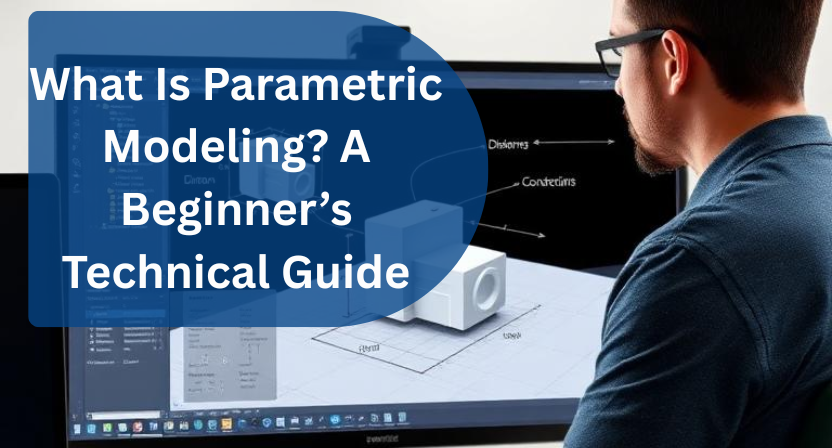
In modern engineering and product development, design is no longer static. Products evolve, specifications change, and multiple variants are often required from a single base model. Parametric Modeling addresses this challenge by enabling designers and engineers to create intelligent, rule-based CAD models that adapt automatically to changes.
This beginner-friendly yet technical guide explains what parametric modeling is, how it works, its core principles, and why it is a foundational skill in CAD and engineering design.
Definition of Parametric Modeling
Parametric Modeling is a CAD modeling methodology in which geometry is defined using parameters, constraints, and feature relationships. Instead of creating isolated shapes, designers build models where dimensions and features are mathematically linked.
When a parameter value changes, the entire model updates automatically while preserving the original design intent.
In technical terms, parametric modeling uses:
- Variable-driven dimensions
- Constraint-based geometry
- Feature-history modeling
This approach allows precise control over complex designs and ensures consistency throughout the model lifecycle.
How Parametric Modeling Works in CAD Software
In parametric CAD systems, every feature is created in a sequential feature tree. Each feature depends on:
- Sketch dimensions
- Geometric constraints
- References to existing geometry
For example:
- A hole diameter may depend on shaft size
- A wall thickness may depend on structural load
- A component length may depend on assembly constraints
Changing a single parameter propagates updates across all dependent features, ensuring accuracy and reducing manual rework.
Popular CAD tools that support parametric modeling include PTC Creo, SolidWorks, Siemens NX, Autodesk Inventor, and Revit.
Core Components of Parametric Modeling
Understanding these core elements is essential for beginners.
1. Parameters
Parameters are numerical values such as length, width, radius, angle, or thickness. They can be controlled manually or driven by equations.
Example:
Wall Thickness = Outer Diameter × 0.05
2. Constraints
Constraints define geometric relationships such as parallel, concentric, perpendicular, tangent, and coincident. They control how features behave when dimensions change.
3. Feature History
Parametric models are history-based. Each operation builds upon the previous one, allowing edits at any stage without rebuilding the entire model.
Advantages of Parametric Modeling in Engineering Design
It offers several technical and business advantages.
Design Intent Preservation
Design intent ensures that functional relationships remain intact even after multiple revisions.
Faster Design Iterations
Engineers can generate multiple design variants quickly by adjusting parameter values.
Error Reduction
Predefined constraints minimize geometric conflicts and dimensional inconsistencies.
Model Reusability
One parametric model can be reused across product families, configurations, and sizes.
Manufacturing Readiness
Parametric models align well with manufacturing processes, tolerances, and downstream CAM workflows.
Parametric Modeling vs Direct Modeling (Technical Comparison)
| Aspect | Parametric Modeling | Direct Modeling |
|---|---|---|
| Design Control | Rule-based | Freeform |
| Feature History | Yes | No |
| Design Intent | Preserved | Limited |
| Best Use Case | Production, engineering | Concept changes |
| Scalability | High | Low |
For engineering-grade designs that require precision, documentation, and repeatability, it is the preferred approach.
Applications of Parametric Modeling Across Industries
It is widely used in:
- Mechanical engineering design (components, assemblies, enclosures)
- Furniture and product design (size variants, modular products)
- BIM and architecture (Revit families, configurable elements)
- Automotive and industrial equipment design
- Manufacturing and tooling development
Its ability to handle design changes efficiently makes it essential in industries where customization and accuracy are critical.
Is Parametric Modeling Suitable for Beginners?
Yes—though it requires a structured mindset.
Beginners should focus on:
- Defining clear design intent
- Using constraints correctly
- Planning feature order logically
While the learning curve exists, it ultimately simplifies complex designs. It prepares designers for professional engineering environments.
Conclusion
Parametric Modeling is a cornerstone of modern CAD and engineering design. By using parameters, constraints, and feature relationships, designers can create intelligent models that adapt seamlessly to change. As a result, beginners who master it build a strong technical foundation while also opening doors to advanced design, automation, and digital engineering workflows.
At Qaxles Technologies, we deliver high-precision parametric modeling services for mechanical engineering, product design, furniture modeling, and BIM applications. In particular, our design approach focuses on robust feature logic, clean parameter control, and future-ready models that support scalability and manufacturing requirements.
When design changes are frequent, reliable parametric CAD models play a critical role. Not only do they reduce errors, but they also speed up revisions, helping businesses scale their products over time. In this context, Qaxles Technologies serves as a trusted engineering design partner.