
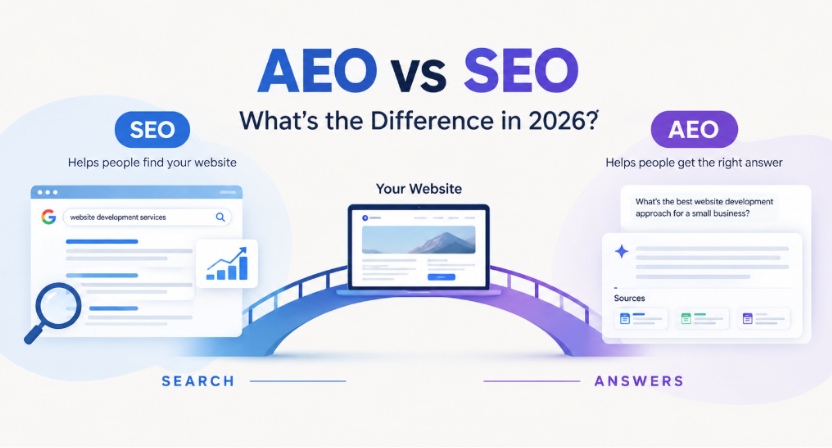
Search is changing faster than it used to. A few years ago, when people wanted information about a product, service, or company, they would type a few keywords into Google, look through the search results, open different websites, and decide which information was useful. Today, the process is becoming much more conversational. People are asking complete questions through AI-powered search experiences and expecting direct, useful answers instead of simply a list of websites.
This change has made AEO vs SEO an important topic for businesses that depend on online visibility. While SEO has been the foundation of digital search for many years, Answer Engine Optimization is becoming increasingly relevant as people use AI-powered tools to find information. But does AEO replace SEO? Not really. In 2026, businesses need to understand how both approaches work together rather than treating them as competing strategies.
What Is SEO?
SEO, or Search Engine Optimization, is the process of improving a website so that search engines can understand its content and show it to people searching for relevant information. Traditional SEO involves many different areas, including keyword research, technical optimization, website structure, internal linking, content quality, backlinks, page speed, mobile usability, and search intent.
For example, imagine that an engineering company provides 3D CAD design services. The company may create a page targeting the keyword “3D CAD design services.” The purpose of SEO is to help that page become visible when potential customers search for that service.
SEO is therefore largely focused on making a website discoverable through traditional search. However, the way people search is changing. Instead of typing short phrases, users are increasingly asking detailed questions that contain more context. This is one of the reasons AEO has become an important part of the modern search conversation.
What Is AEO?
AEO stands for Answer Engine Optimization. It focuses on creating and structuring content so that it can provide clear and useful answers to questions asked by users through search engines and AI-powered answer experiences.
The difference can be understood with a simple example. Someone searching for “website development cost” is using a relatively broad query. Another person might ask, “How much does it cost to build a professional website for a small manufacturing company?” The second question gives much more information about what the person actually wants to know.
AEO encourages businesses to think beyond individual keywords and understand the questions, problems, and decisions behind those searches. Instead of simply creating a page that mentions “website development cost” several times, a useful AEO-focused article would explain what affects website development costs, what different types of websites may cost, how long development can take, and what a business should consider before choosing a development company.
AEO vs SEO: What Is the Difference?
The easiest way to understand AEO vs SEO is to think about their primary goals. SEO focuses heavily on helping content become discoverable in search results, while AEO focuses on making information easy to understand and useful as a direct answer.
However, there is considerable overlap between them. A website still needs a strong technical foundation, useful content, clear structure, and good user experience. These fundamentals don’t suddenly become irrelevant because people are using AI-powered search.
In fact, AEO should be viewed as an additional layer rather than a complete replacement for SEO. A business that ignores technical SEO but creates question-and-answer content everywhere on its website is unlikely to have a strong long-term search strategy.
Why Is AEO Becoming Important in 2026?
One of the biggest changes in search is the shift from short keyword searches to conversational queries. People are no longer always searching for a single phrase. They are asking questions that sound more like conversations.
For example, instead of searching for “best CRM software,” someone might ask, “What is the best CRM for a 20-person B2B company that needs simple lead tracking without a complicated setup?” The second search contains information about the user’s business size, industry, requirements, and limitations.
For an answer engine to provide a useful response, it needs to understand all of that context. This means businesses need to create content that doesn’t simply target keywords but actually explains topics clearly and completely.
This does not mean that keywords have become useless. Keywords still help search systems understand what a page is about. The difference is that modern content needs to go further by addressing the real information need behind the search.
A Common Mistake Businesses Make With AEO
When businesses first learn about AEO, one of the most common reactions is to create large numbers of FAQ pages. They may publish dozens or even hundreds of pages answering simple questions because they believe that having more questions will automatically increase their chances of appearing in AI-generated answers.
That approach can easily produce thin and repetitive content. Simply changing a statement into a question does not make it valuable.
For example, creating a page titled “What Is Digital Marketing?” and filling it with a short definition that can be found on hundreds of other websites doesn’t give users much reason to visit that page. The real opportunity is to provide something more useful, such as practical examples, industry-specific information, original observations, or explanations based on actual experience.
AEO should not become a process of producing thousands of questions. It should become a process of understanding what customers genuinely want to know and answering those questions better.
The Second Question Principle
Here is one approach that can make AEO content more useful: the Second Question Principle.
When someone asks a question, don’t stop after answering it. Think about what they are most likely to ask next.
For example, if someone searches for “What is AEO?”, their next question may naturally be “Do I still need SEO?” After that, they may wonder, “How do I optimize my website for AEO?” They may then ask, “How can I measure whether my AEO strategy is working?”
This creates a natural content journey. Instead of answering one question and leaving the reader to search somewhere else, your content can anticipate the next question and provide the information they need.
This approach is different from simply adding an FAQ section at the end of every blog post. It is about understanding the reader’s thought process and building the article around that journey.
A useful structure can look like this: Question → Answer → Next Question → Deeper Explanation → Practical Action.
This is particularly valuable for businesses because customers rarely make a purchase decision after answering just one question. They usually have several doubts before they are ready to contact a company.
Does AEO Replace SEO?
No. AEO should not be considered a replacement for SEO.
SEO remains important because websites still need to be crawlable, indexable, technically sound, fast, mobile-friendly, and well structured. Search engines also continue to rely on signals that help them understand the relevance and quality of web pages.
At the same time, AEO gives businesses another way to think about content. Instead of asking only, “What keyword should this page rank for?”, businesses can also ask, “What question is my potential customer trying to answer?”
The strongest strategy is therefore not SEO versus AEO. It is SEO combined with AEO.
SEO provides the foundation. AEO helps make the information within that foundation clearer and more useful for conversational and answer-driven search experiences.
How Businesses Can Optimize for AEO
The first step is to make sure your existing SEO foundation is healthy. Before worrying about AI search, check whether your website can be properly crawled and indexed. Make sure important pages are accessible, the site works well on mobile devices, internal links are logical, and technical issues are not preventing search engines from understanding your website.
The next step is to identify the questions your customers actually ask. Your best sources may not be keyword research tools. Your sales team, customer support team, emails, enquiries, meetings, and conversations with customers can reveal questions that people genuinely care about.
Once you have those questions, create content that answers them properly. Don’t worry about making every article a specific length. A simple question may need a few hundred words, while a complicated business decision may require a detailed guide.
Original experience is another important factor. If your company has worked on real projects, encountered common customer problems, tested different solutions, or learned lessons from the industry, include those insights in your content. This is the type of information that makes a page more useful than a generic article repeating information already available everywhere.
Why Original Content Matters More Than Ever
There is already an enormous amount of information available online. AI can generate definitions, lists, summaries, and basic explanations in seconds. Because of this, simply producing more content is not necessarily a competitive advantage.
The value comes from producing information that has a reason to exist.
A company that has real industry experience can explain things differently from a website that has only researched the topic. For example, an engineering company can discuss problems it has actually encountered during CAD projects. A web development company can explain why certain website decisions worked for particular businesses. A marketing company can share lessons from campaigns it has actually managed.
This type of content gives your website a perspective rather than just information.
How Should AEO Success Be Measured?
Measuring AEO is not as straightforward as looking at a traditional keyword ranking. Businesses should look at a combination of signals.
Traditional SEO metrics such as organic impressions, clicks, rankings, click-through rates, and conversions are still important. At the same time, businesses should pay attention to whether their content is being discovered through conversational searches and whether those searches are contributing to website visits, enquiries, or other meaningful actions.
Ultimately, the most important question isn’t simply whether an article appears in a search result or AI-generated answer. The bigger question is whether the content is helping the right people discover the business and move closer to making a decision.
AEO vs SEO: Which One Matters More in 2026?
If a business has a technically weak website, poor content structure, and little organic visibility, SEO should remain the priority. There is little benefit in focusing heavily on AEO while the basic search foundation is broken.
For an established website with a strong SEO foundation, however, AEO deserves much more attention. As users become more comfortable asking detailed questions through AI-powered search experiences, businesses have an opportunity to become useful sources of information rather than simply another result on a search page.
So, which matters more in 2026?
The better answer is that businesses shouldn’t choose one.
SEO helps your website get discovered. AEO helps your information become an answer.
The two strategies can work together to create a stronger search presence.
The Future Is Not AEO vs SEO
The discussion around AEO vs SEO sometimes makes it sound as though one will eventually replace the other. Search is more complicated than that.
SEO continues to provide the technical and content foundation that websites need. AEO adds another way of thinking about how information is presented and discovered. Alongside these, original content, first-hand experience, brand credibility, and genuine usefulness are becoming increasingly important.
The businesses that adapt well will not simply create content because a keyword has search volume. They will create content because customers have questions that need good answers.
That is the real opportunity.
Instead of asking, “How many keywords should we include in this article?”, ask, “What does our customer need to understand before they can make a confident decision?”
That change in mindset can completely change the way a business approaches content.
Conclusion
The AEO vs SEO debate doesn’t really need a winner. SEO and AEO solve related but slightly different problems, and both can play an important role in a modern digital strategy.
SEO helps your website become visible and accessible to search engines. AEO encourages you to organize and explain information in a way that directly addresses the questions people are asking.
But the most important strategy is bigger than either acronym.
Create useful content. Answer real questions. Add your own experience. Explain things clearly. Think about the question that comes after the first question. Most importantly, give people information that they cannot get from ten other websites simply by reading the same generic definition.
In 2026, the goal shouldn’t be just to optimize a page so that it can be found.
The goal should be to build a website that is worth finding, worth reading, and worth being referenced.