
In today’s competitive manufacturing industry, companies are constantly searching for ways to improve product performance while keeping costs under control. This is where value engineering plays an important role in mechanical product design.
Value engineering is not simply about reducing expenses. It is a structured approach used to improve the value of a product by analyzing its functions, materials, manufacturing methods, and overall performance. The goal is to achieve better efficiency, reliability, and cost optimization without affecting quality.
For industries such as HVAC, industrial equipment, automotive, consumer products, and thermal systems, value engineering has become an essential part of modern product development.
Understanding Value Engineering in Mechanical Design
In mechanical product design, every component contributes to the overall functionality of the product. However, not every feature or material adds equal value. Through value engineering, engineers identify areas where improvements can be made without compromising performance or customer expectations.
For example, a product may contain components that are expensive to manufacture but provide minimal functional benefit. By redesigning the component, selecting alternative materials, or simplifying the assembly process, companies can significantly reduce manufacturing costs while maintaining product reliability.
This approach helps manufacturers develop products that are both technically efficient and commercially competitive.
Why Value Engineering Matters
Mechanical products are becoming more complex as industries demand higher performance, compact designs, faster production, and energy efficiency. At the same time, companies must manage rising material costs and tight project budgets.
Value engineering helps businesses address these challenges by improving the balance between cost, functionality, and manufacturability.
Some of the key benefits include:
- Reduction in manufacturing and production costs
- Improved product performance and durability
- Simplified product assembly
- Better material utilization
- Faster product development cycles
- Reduced product weight and complexity
- Enhanced maintainability and serviceability
By implementing value engineering early in the design stage, companies can avoid costly redesigns and manufacturing issues later in the project lifecycle.
The Role of Value Engineering During Product Development
Value engineering can be applied at different stages of mechanical product development. The earlier it is introduced, the greater the potential savings and improvements.
Concept Design Stage
During the concept phase, engineers evaluate multiple design approaches to identify the most efficient solution. This includes analyzing product functions, expected performance, and manufacturing feasibility.
At this stage, value engineering helps teams avoid overdesigning products and encourages practical design decisions from the beginning.
Material Selection
Material costs can heavily impact the total product cost. Through value engineering, engineers assess whether alternative materials can provide similar strength, durability, or thermal performance at a lower cost.
In some cases, replacing machined metal parts with sheet metal, cast components, or engineered plastics can significantly reduce production expenses.
Manufacturing Optimization
Manufacturing processes also play a major role in product cost. It focuses on simplifying fabrication, reducing unnecessary machining operations, minimizing assembly steps, and improving production efficiency.
Design modifications that support easier manufacturing often lead to faster production and fewer quality issues.
Product Performance Improvement
It is not limited to cost reduction alone. It also helps improve product functionality and operational performance.
For example, in thermal or HVAC systems, optimized airflow paths, improved heat dissipation, or reduced component weight can enhance overall system efficiency while lowering production costs.
Value Engineering and CAD Design
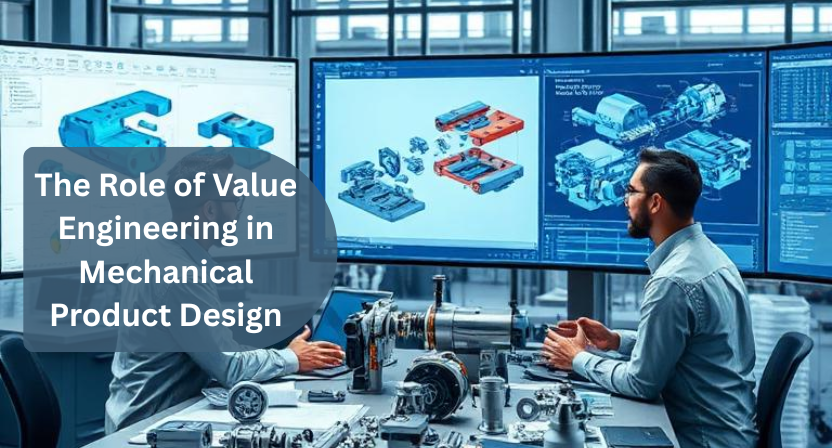
Modern CAD tools have made it more effective than ever before. Engineers can quickly analyze multiple design alternatives, perform simulations, and validate product performance before manufacturing begins.
Using CAD modeling and engineering analysis, design teams can:
- Identify unnecessary material usage
- Optimize component geometry
- Reduce assembly complexity
- Improve structural performance
- Enhance thermal efficiency
This digital approach helps companies make informed engineering decisions while reducing development risks.
Real-World Example of Value Engineering
Consider an industrial enclosure that originally uses thick machined aluminum components. After conducting a study, the design team may discover that a sheet metal fabrication approach can achieve the same structural strength with reduced material cost and shorter manufacturing lead time.
Similarly, in HVAC product design, redesigning airflow channels and optimizing fan placement may improve cooling efficiency while reducing power consumption.
These small but strategic design improvements can create substantial long-term savings for manufacturers.
Challenges in Implementing Value Engineering
Although it offers many benefits, successful implementation requires proper engineering expertise and collaboration between design, manufacturing, procurement, and quality teams.
Some common challenges include:
- Resistance to design changes
- Lack of cross-functional collaboration
- Limited analysis during early design stages
- Overemphasis on cost reduction alone
Effective value engineering should always focus on improving overall product value rather than simply lowering costs.
Conclusion
Value engineering has become an essential strategy in mechanical product design for companies aiming to improve efficiency, reduce manufacturing costs, and deliver better-performing products.
By analyzing product functionality, optimizing materials, and simplifying manufacturing processes, businesses can achieve long-term competitive advantages without compromising quality.
As industries continue to demand smarter, faster, and more cost-effective engineering solutions, it will remain a critical part of successful product development.
At Qaxles Technologies, we support engineering teams with mechanical design optimization, CAD modeling, product development, and engineering solutions that help improve product value and manufacturability.