
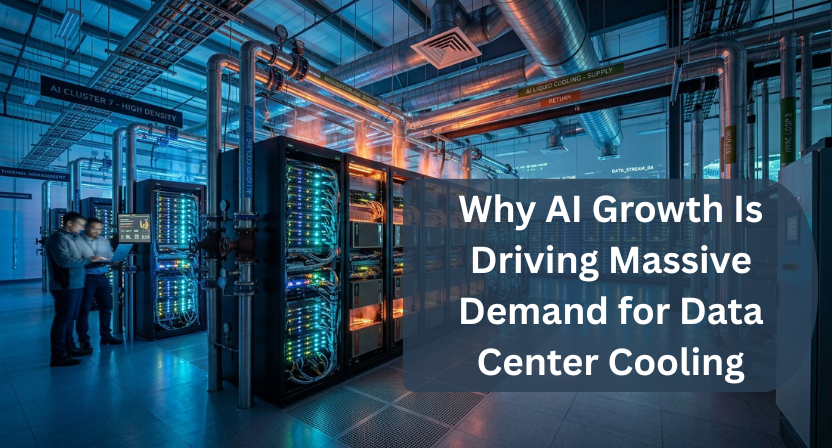
Artificial Intelligence is no longer a future concept discussed only in research labs. Today, AI is being integrated into almost every industry, from healthcare and automotive to manufacturing, finance, and e-commerce. As companies race to build faster and smarter AI systems, one critical challenge is growing just as rapidly behind the scenes: data center cooling.
Most people focus on the power of AI chips, advanced GPUs, and cloud infrastructure. But very few talk about the enormous amount of heat these systems generate every second. In reality, without efficient cooling systems, modern AI infrastructure simply cannot operate reliably.
AI Workloads Are Pushing Data Centers Beyond Traditional Limits
Traditional data centers were originally designed for standard computing workloads such as storage, networking, and business applications. AI has completely changed that environment.
Training large AI models requires thousands of high-performance GPUs working continuously for long periods. These processors consume massive amounts of electricity and generate extreme heat densities inside servers and racks.
The explosive growth of Artificial Intelligence (AI) is driving a massive, urgent demand for advanced data center cooling because AI servers, particularly those using advanced GPUs, generate unprecedented levels of heat that conventional air-based systems cannot manage.
This is becoming one of the biggest engineering challenges for data center operators worldwide.
Why Conventional Cooling Systems Are Struggling
For many years, air cooling was sufficient for most server rooms and data centers. Cool air would circulate through server racks, while hot air would be removed using HVAC systems.
However, AI computing environments are operating at much higher power densities than traditional IT infrastructure. In many AI-focused facilities, rack power can exceed 50kW to 100kW per rack far beyond what older cooling methods were designed to handle.
As a result, companies are now investing heavily in advanced data center cooling technologies such as:
- Liquid cooling
- Direct-to-chip cooling
- Immersion cooling
- Rear-door heat exchangers
- Intelligent thermal management systems
These solutions help remove heat more efficiently while reducing energy consumption and operational risks.
The Link Between AI Growth and Energy Consumption
AI infrastructure does not only create heat it also consumes enormous amounts of electricity. As data centers expand to support AI workloads, energy efficiency has become a major business priority.
Cooling systems alone can account for a large percentage of total data center energy usage. Poor thermal management increases operational costs, reduces hardware lifespan, and creates performance instability.
This is why modern data center cooling is no longer viewed as just a maintenance requirement. It has become a strategic investment directly connected to performance, uptime, and sustainability.
Liquid Cooling Is Gaining Momentum
One of the biggest shifts happening in the industry is the move toward liquid cooling technologies.
Unlike air, liquids can absorb and transfer heat much more efficiently. This makes liquid cooling highly effective for AI servers that operate under extremely high thermal loads.
Many hyperscale companies and AI infrastructure providers are already adopting liquid-based systems to support next-generation GPU clusters.
The demand is expected to rise significantly over the next few years as AI adoption continues across industries.
Sustainability Is Becoming a Key Driver
Environmental concerns are also accelerating innovation in data center cooling.
Governments, investors, and customers are placing increasing pressure on organizations to reduce carbon emissions and improve energy efficiency. Since cooling systems consume substantial power, optimizing thermal management plays a major role in achieving sustainability targets.
Modern cooling strategies now focus on:
- Lower power consumption
- Water efficiency
- Heat recovery systems
- Smart monitoring and automation
- Reduced environmental impact
Companies that improve cooling efficiency can significantly lower operational costs while meeting ESG and sustainability goals.
Engineering Innovation Is Creating New Opportunities
The rapid evolution of AI infrastructure is opening major opportunities for engineering companies, HVAC specialists, thermal simulation experts, and product design teams.
Designing efficient cooling systems now requires expertise in:
- Mechanical engineering
- CFD analysis
- Thermal simulation
- Airflow optimization
- Heat exchanger design
- Digital engineering technologies
As AI infrastructure continues to scale globally, the demand for specialized engineering support in data center cooling will continue growing.
The Future of Data Center Cooling
AI is reshaping the entire data center industry. The focus is no longer only on computing power it is also about how efficiently that power can be managed and cooled.
Companies that fail to modernize their cooling infrastructure may face higher operational costs, performance limitations, and increased downtime risks.
On the other hand, businesses investing in advanced data center cooling technologies will be better positioned to support the next generation of AI applications.
In many ways, the future of AI will depend not only on processing power, but also on how effectively the industry can solve its cooling challenges.
Conclusion
The rise of AI is creating unprecedented pressure on global data center infrastructure. As computing demands continue to increase, efficient data center cooling is becoming one of the most important technologies enabling AI growth.
From liquid cooling systems to intelligent thermal management solutions, the industry is entering a new era of innovation focused on performance, reliability, and sustainability.
For businesses operating in engineering, HVAC, thermal management, and digital infrastructure, this shift presents major opportunities for innovation and expansion.
At Qaxles Technologies, we support thermal engineering, HVAC, and refrigeration companies with external engineering design services tailored to modern product development requirements. Our team can assist with CAD modeling, sheet metal enclosure design, mechanical engineering support, product digitalization, PDM/PLM support, and engineering documentation for cooling system and data center infrastructure projects.
As AI infrastructure continues to evolve, collaboration between cooling technology providers and engineering design partners will play a critical role in accelerating development, reducing design iteration cycles, and supporting scalable innovation.