
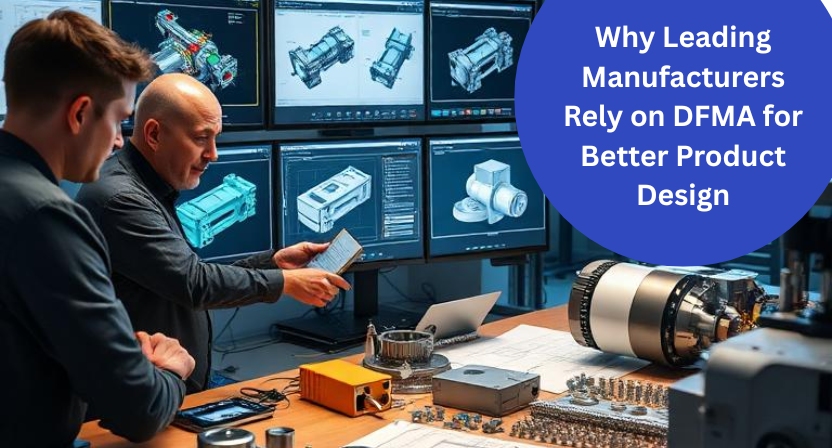
In today’s competitive manufacturing landscape, designing a product that simply works is no longer enough. Products must be cost-effective to manufacture, easy to assemble, reliable in the field, and ready to scale for production. This is where DFMA (Design for Manufacture and Assembly) becomes an essential part of modern product development.
Leading manufacturers across industries from automotive and industrial equipment to consumer electronics and medical devices have embraced DFMA because it helps bridge the gap between design and production. Instead of identifying manufacturing issues after a prototype is built, DFMA encourages engineers to consider manufacturability and assembly from the very beginning of the design process.
The result is a product that reaches the market faster, costs less to produce, and performs more consistently throughout its lifecycle.
What Is DFMA?
DFMA (Design for Manufacture and Assembly) is an engineering methodology that combines two complementary approaches:
- Design for Manufacture (DFM): Ensures that every component can be produced efficiently using the selected manufacturing process.
- Design for Assembly (DFA): Focuses on simplifying product assembly by reducing unnecessary parts and making assembly operations quicker and less prone to errors.
Together, these principles help engineers develop products that are easier to manufacture, assemble, inspect, maintain, and improve over time.
Why DFMA Has Become a Standard Practice
Manufacturers today face increasing pressure to reduce production costs while maintaining high quality and shorter delivery schedules. Every additional part, machining operation, fastener, or assembly step adds time, cost, and potential quality risks.
DFMA addresses these challenges before they reach the factory floor.
Instead of asking, “Can we manufacture this?” after completing the design, engineers ask, “What’s the simplest and most efficient way to manufacture and assemble this?” during the design phase itself.
This change in mindset creates significant long-term value.
Key Benefits of DFMA
1. Lower Manufacturing Costs
One of the biggest advantages of DFMA is cost reduction.
A design with fewer complex features often requires fewer machining operations, less tooling, lower material waste, and shorter production cycles.
Even a small improvement in part geometry can save thousands of dollars when products are manufactured in large volumes.
2. Reduced Part Count
Every component in a product has a purpose, but not every component is necessary.
DFMA encourages engineers to question whether two or more parts can be combined into one without affecting functionality.
Reducing part count leads to:
- Lower inventory requirements
- Simpler procurement
- Reduced assembly time
- Lower quality inspection effort
- Fewer opportunities for assembly mistakes
Many successful products achieve better performance simply by becoming mechanically simpler.
3. Faster Assembly
Assembly is often one of the most labor-intensive stages of manufacturing.
DFMA helps engineers design products that are intuitive to assemble by:
- Reducing fasteners
- Eliminating unnecessary adjustments
- Designing self-locating components
- Standardizing hardware
- Improving accessibility for tools
Shorter assembly times directly improve production capacity without requiring additional resources.
4. Improved Product Quality
Complex products generally introduce more opportunities for defects.
When designs become simpler, quality naturally improves.
With fewer parts and assembly operations:
- Assembly errors decrease.
- Inspection becomes easier.
- Component alignment improves.
- Product consistency increases.
This contributes to higher customer satisfaction and fewer warranty claims.
5. Shorter Product Development Cycles
Late-stage design changes are expensive.
If manufacturability problems are discovered after prototypes are built, engineering teams often need multiple redesign iterations.
DFMA identifies these issues early.
This reduces engineering rework and helps products move from concept to production much faster.
6. Better Collaboration Between Teams
Traditional product development sometimes creates barriers between design engineers and manufacturing engineers.
DFMA encourages collaboration from the beginning.
Design teams, manufacturing specialists, quality engineers, procurement teams, and assembly personnel all contribute valuable insights during development.
This collaborative approach results in products that work well not only on a computer screen but also in real production environments.
Industries That Benefit Most from DFMA
DFMA delivers measurable benefits across a wide range of industries, including:
- Automotive components
- Industrial machinery
- HVAC equipment
- Sheet metal enclosures
- Consumer electronics
- Medical devices
- Aerospace components
- Electrical equipment
- Robotics
- Renewable energy systems
Regardless of the industry, the objective remains the same: simplify the design while maintaining performance.
Practical DFMA Techniques Used by Engineers
Successful engineering teams often apply several DFMA principles during product development:
- Minimize the total number of components.
- Use standard parts wherever possible.
- Design parts that can only be assembled in the correct orientation.
- Avoid unnecessary tight tolerances.
- Reduce custom fasteners.
- Design features that support automated manufacturing.
- Select manufacturing processes early in the design phase.
- Simplify sheet metal bends and formed features.
- Optimize material selection based on production methods.
These seemingly small decisions collectively create substantial improvements in manufacturing efficiency.
A Unique Perspective: Design for the “Second Assembly”
One often-overlooked aspect of DFMA is what can be called the “Second Assembly Principle.”
Most DFMA discussions focus on the initial manufacturing process. However, leading engineering teams increasingly consider the product’s second assembly the moment when the product is serviced, upgraded, repaired, refurbished, or recycled years after production.
For example, if replacing a single component requires removing twenty fasteners or dismantling multiple subassemblies, maintenance costs rise significantly over the product’s lifetime.
Designing with future serviceability in mind can provide benefits such as:
- Faster field repairs
- Reduced maintenance downtime
- Easier product upgrades
- Improved remanufacturing opportunities
- Better sustainability through simplified recycling and component reuse
This lifecycle-focused approach extends traditional DFMA thinking beyond manufacturing and assembly, helping manufacturers reduce the total cost of ownership for both themselves and their customers. While many organizations emphasize production efficiency, considering the “second assembly” during the design phase can become a valuable competitive advantage.
Common DFMA Mistakes to Avoid
Even experienced engineering teams can overlook important DFMA principles.
Some common mistakes include:
- Designing parts without understanding manufacturing limitations.
- Using too many unique fasteners.
- Creating unnecessary cosmetic features that increase machining time.
- Applying tighter tolerances than required.
- Ignoring assembly tool access.
- Overcomplicating sheet metal designs.
- Waiting until prototype testing to evaluate manufacturability.
Avoiding these issues early reduces delays and unexpected production costs.
How Digital Engineering Supports DFMA
Modern engineering software has transformed how DFMA is implemented.
Using advanced CAD platforms, simulation tools, tolerance analysis, and product lifecycle management (PLM) systems, engineers can identify potential manufacturing challenges long before production begins.
Digital workflows also enable teams across multiple locations to review designs, evaluate assembly processes, and implement improvements collaboratively, reducing costly surprises during manufacturing.
The Future of DFMA
As manufacturers adopt automation, robotics, digital twins, and smart factories, DFMA will play an even more strategic role.
Future product designs will increasingly be optimized not only for human assembly but also for robotic assembly, automated inspection, and sustainable manufacturing.
Organizations that integrate DFMA into every stage of product development will be better positioned to reduce costs, improve product quality, and accelerate innovation in an increasingly competitive market.
Conclusion
DFMA is more than an engineering methodology it is a practical way of thinking that improves every stage of product development. By considering manufacturing and assembly requirements from the earliest design decisions, companies can reduce production costs, simplify assembly, improve quality, shorten development cycles, and create products that are easier to maintain throughout their lifecycle.
At Qaxles Technologies, we help manufacturers transform design concepts into production-ready solutions through practical engineering expertise. From CAD modeling and sheet metal design to engineering optimization, ECO/ECR implementation, and DFMA-driven product development, our team focuses on creating designs that are efficient to manufacture, simple to assemble, and built for long-term performance. By integrating DFMA principles into every project, we help clients accelerate product development while reducing manufacturing complexity and overall production costs.