
Data centers generate a significant amount of heat. Without an effective cooling system, servers can overheat, leading to reduced performance, equipment failures, and costly downtime. This is why selecting the right cooling solution is one of the most important decisions for any data center manager.
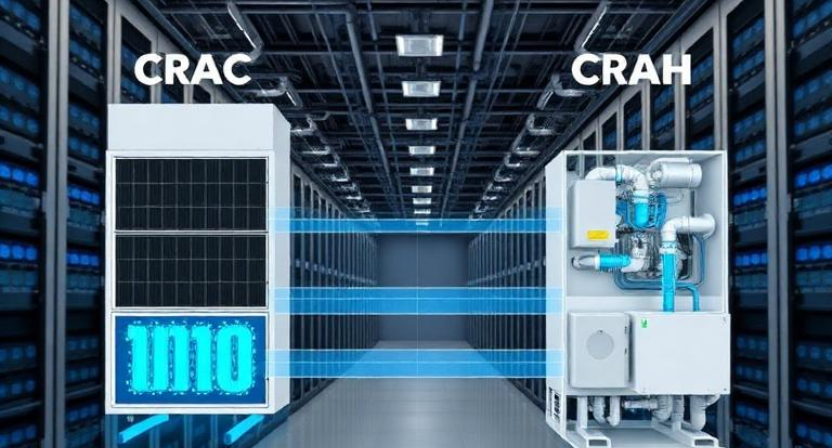
When discussing data center cooling, two technologies are often compared: CRAC units and CRAH units. While both are designed to maintain optimal temperature and humidity levels, they operate differently and are suited for different environments.
In this guide, we’ll explore the key differences between CRAC and CRAH units, their advantages, and how to determine which solution best fits your data center.
What Are CRAC Units?
CRAC stands for Computer Room Air Conditioning.
A CRAC unit works much like a traditional air conditioning system. It uses a refrigeration cycle that includes compressors, condensers, evaporators, and refrigerants to cool the air directly.
The unit pulls warm air from the data center, removes heat through the refrigeration process, and then delivers cooled air back into the room.
Key Features of CRAC Units
- Self-contained cooling system
- Uses refrigerant-based cooling
- Equipped with compressors
- Suitable for smaller and medium-sized data centers
- Easier to install in existing facilities
Advantages of CRAC Units
- Simple installation and operation
- Lower initial investment
- Independent cooling solution
- Effective for facilities with moderate cooling requirements
Limitations of CRAC Units
- Higher energy consumption due to compressor operation
- Less efficient at large-scale cooling loads
- Increased maintenance requirements because of moving mechanical components
What Are CRAH Units?
CRAH stands for Computer Room Air Handler.
Unlike CRAC units, CRAH units do not use compressors to cool air. Instead, they rely on chilled water supplied from a central chiller plant.
Warm air from the data center passes through chilled water coils inside the CRAH unit. The heat is transferred to the chilled water, and the cooled air is then distributed throughout the facility.
Key Features of CRAH Units
- Uses chilled water for cooling
- No internal refrigeration cycle
- Lower power consumption
- Ideal for large-scale data centers
- Often integrated with centralized cooling infrastructure
Advantages of CRAH Units
- Higher energy efficiency
- Lower operating costs
- Better scalability for growing facilities
- Reduced compressor-related maintenance
Limitations of CRAH Units
- Requires a chilled water system
- Higher infrastructure investment
- More complex installation process
CRAC Units vs CRAH Units: Side-by-Side Comparison
| Feature | CRAC Unit | CRAH Unit |
|---|---|---|
| Cooling Method | Refrigerant-based | Chilled water-based |
| Compressor | Yes | No |
| Energy Efficiency | Moderate | High |
| Initial Cost | Lower | Higher |
| Operating Cost | Higher | Lower |
| Maintenance | More frequent | Generally lower |
| Scalability | Limited | Excellent |
| Best For | Small to medium data centers | Large enterprise and hyperscale data centers |
Which System Is More Energy Efficient?
Energy efficiency has become a top priority for modern data centers, especially as power costs continue to rise.
CRAH units generally outperform CRAC units in terms of energy efficiency. Since CRAH systems rely on chilled water and do not use energy-intensive compressors within the unit, they consume less power during operation.
For organizations focused on reducing operational costs and improving Power Usage Effectiveness (PUE), CRAH systems often provide a significant advantage.
When Should You Choose a CRAC Unit?
A CRAC unit may be the right choice if:
- Your facility is small or medium-sized
- You do not have an existing chilled water infrastructure
- You need a straightforward installation
- Initial budget constraints are a major consideration
CRAC systems remain a practical solution for many enterprise server rooms and edge computing facilities.
When Should You Choose a CRAH Unit?
A CRAH unit is often the better option if:
- You operate a large-scale data center
- Energy efficiency is a top priority
- You already have a central chiller plant
- Long-term operational savings are important
- Future expansion is expected
Many hyperscale and colocation data centers prefer CRAH systems because of their ability to support higher cooling capacities while maintaining energy efficiency.
Emerging Trends in Data Center Cooling
As artificial intelligence, cloud computing, and high-density server deployments continue to grow, cooling technologies are evolving rapidly.
Modern facilities are increasingly adopting:
- High-efficiency CRAH systems
- Rear-door heat exchangers
- Liquid cooling solutions
- Immersion cooling technologies
- AI-driven cooling optimization
Despite these innovations, both CRAC and CRAH units continue to play a critical role in data center thermal management.
Conclusion
Choosing between CRAC and CRAH units depends on several factors, including facility size, cooling requirements, infrastructure availability, and long-term operational goals.
CRAC units offer simplicity and lower upfront costs, making them suitable for smaller environments. CRAH units, on the other hand, provide superior energy efficiency and scalability, making them the preferred choice for larger and more demanding data centers.
Before making a decision, data center managers should carefully evaluate both current cooling needs and future growth plans. The right cooling strategy can improve equipment reliability, reduce energy costs, and support long-term business success.
Need Engineering Support for Data Center Cooling Projects?
Qaxles Technologies provides mechanical engineering design, CAD modeling, sheet metal design, manufacturing drawings, and engineering documentation services for HVAC and data center cooling equipment manufacturers worldwide.
Contact our team to learn how we can support your next cooling infrastructure project.